New Book: Corinna’s Guide to Facilitating Retrospectives

There’s a new book in the multiverse of Retromat books:

My series of posts for beginners is now available as a book for more convenient reading. Of course, it’s also part of the Retromat eBook bundle, which now contains five books in total.

Because five might feel overwhelming if you’re only getting started, here’s the recommended reading order:

The last two don’t have an inherent order – read them whenever you feel like they would help:

PS: If you want to help make Retromat more awesome, why not become a Retro Mate?

18. Other Resources

[This post is part of Corinna’s Guide to Facilitating Retrospectives]

My dear friend,

we are nearing the end of this course. Obviously there are more resources for retrospectives out there than just Retromat. First and foremost the book that started my own journey so many years ago – It’s still the quasi standard and I highly recommend it: Agile Retrospectives

There are also my own books.

In terms of finding activities, I pretty much use Retromat exclusively, since I built it to scratch my own itch. But if you’re looking for more variety, check out: FunRetrospectives.com and “games” at TastyCupcakes.org. (TastyCupcakes seems to be down as of October 2025)

For my final trick, I’d like to go beyond retrospectives and introduce some concepts that I found immensely useful during my journey as an Agile Coach. It’ll just be a sentence or two per idea and you can follow the link for the ones that seem helpful to you:

Liberating Structures

A treasure trove of facilitation methods that aim to involve as many participants as possible as active contributors, while still moving everything forward.

More on Liberating Structures

Host Leadership

You might have heard of Servant Leadership as a metaphor for roles like Scrum Master. It sounded good in 2010 when I started out. I quickly realized that it is very hard to set boundaries and establish “that’s not how we behave in this team / during this meeting / …” with that mindset. I think that Servant Leadership as a metaphor is seriously broken and that Host Leadership is the much more helpful metaphor. Servants can’t throw people out that ignore the community rules. Hosts can. 

More on Host Leadership 

Multipartiality 

For the longest time I thought it was my job as a facilitator to be neutral and impartial. Nowadays I believe I need to be multipartial, i. e. I need to be able to understand each party’s point of view.

More on Multipartiality

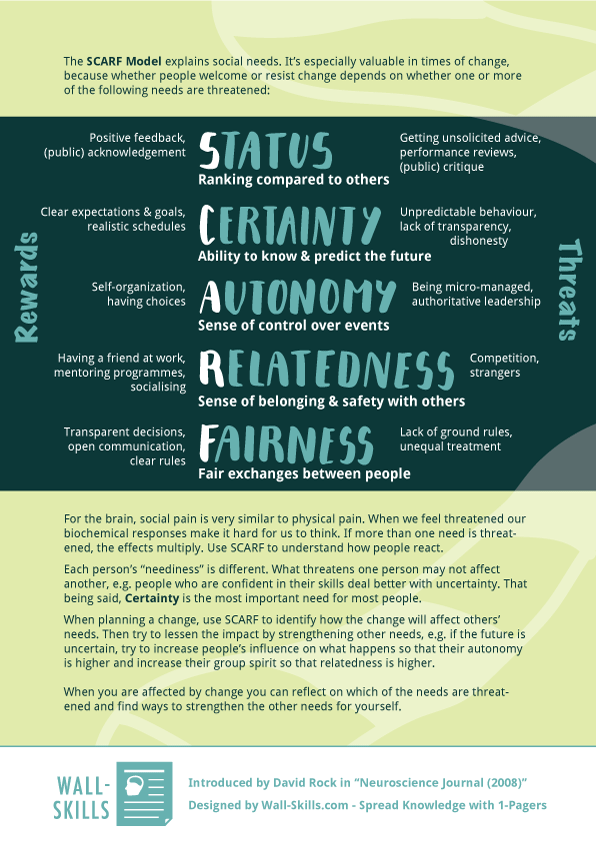
SCARF

The SCARF Model explains social needs: Status, Uncertainty, Autonomy, Relatedness, and Fairness. It’s especially valuable in times of change, because whether people welcome or resist change depends on whether their SCARF needs are threatened or strengthened.

More on the SCARF Model

Clean Feedback

The world would be a much better place if more people were aware of the difference between their observations and their interpretations of these observations. 

More on the Clean Feedback Model


Take a minute:
Which concept sounds like it could really help you in your current situation?

Please help me make this course better for everyone who will read it after you and tell me in the comments:

  • What helped you? 
  • What was baffling? 
  • What are you still wondering about?

See you next time for my farewell message,

Corinna

PS: If you'd rather read this Guide as an ebook, click here. Or go all in and get it as part of the Retromat eBook Bundle at a discount. A purchase also supports Retromat as a whole 🙂

17. Smoother Retrospectives with a Kick-Off

[This post is part of Corinna’s Guide to Facilitating Retrospectives]

Howdy friend!

If it feels like your team is storming a lot… Might I ask, if there ever was a team kick-off? 

When health is concerned, preventing issues altogether is often easier than treating them once they manifest. The same can be said for retrospectives:

“In retrospectives we often make up for the fact that we didn’t have a liftoff”

Either Deborah Hartmann Preuss or Steve Holyer said that to me in a conversation years ago and it still rings true. Very few teams get a proper kick-off and they lose weeks and months of productivity to initial friction. In contrast, a proper kick-off sets a team up for success by laying a solid foundation of agreements and shared understandings. Then the team doesn’t have to spend many a retrospective slowly patching up problems that were completely avoidable.

So, what if you missed the start? You didn’t have a kick-off at the beginning and the project is already underway. Your team is busy patching up cracks in the foundation instead of “clicking”? Well, it’s never too late to reboot with a mid-project kick-off to (re)gain footing.

But wait, what is a kick-off exactly?

You might know them as liftoffs, jump starts, launches or project starts – a meeting at the beginning of a team coming together and starting to work on something. It’s a longer event, lasting from a day up to a week. All the necessary people take part, i.e. the team, the project sponsor and whoever else is needed to provide context and insights. Many kick-offs are off-site to improve focus.

What if I can’t do one?

If you can’t convince the “powers that be” to invest the time, you can still purposefully pick kick-off-ish activities to clarify things such as:

Pick whatever pains the team the most and take it from there. Compensating via retros is the second best thing. Especially for strategic alignment and project goals you really do want kick-offs though, trust me. Typically, the project sponsor (the person who wanted that initiative in the first place and is championing it within the company) does not take part in the retros and that is crucial knowledge and missing context, if it wasn’t laid as a foundation. 

Typing this out, I again realize how important kick-offs are to me and how much I want to create a dedicated board or book with activities for this topic. In the meantime, check out 

  • “Liftoff” by Diana Larsen and Ainsley Nies. It is excellent!
  • And coming to think of it: My own book “Plans for Retrospectives” contains *checks* two plans specifically for newly-formed teams (and three more for teams that are new to agile)

Take a minute:
Has your team or project had a proper kickoff? Is there anything that seems to be missing for the team to gel or to take good decisions regarding their work outcomes? How can you get them what they need?

Wow, I can’t believe we’re almost done with the course. Only two more weeks to go. Yay, you, for sticking with it!

Have a great week,

Corinna

PS: What would you need from a product around kick-offs to best support you in your work? 

PS: If you'd rather read this Guide as an ebook, click here. Or go all in and get it as part of the Retromat eBook Bundle at a discount. A purchase also supports Retromat as a whole 🙂
Corinna’s Guide to Facilitating Retrospectives

Hello there,

welcome to this course about retrospectives, friend!

First things first: this course will be biased. I started out writing a neutral course and it did not feel right. Because, I would write down one thing and then go do something else in practice. So I scratched that first version and we’ll be doing it differently:

Imagine you have just started as my colleague. It’s your first position as a Scrum Master (or Agile Coach or …) and I’m supposed to show you how to facilitate effective retrospectives. It’ll be very personal, very “this is how I do it in this specific context, your context might be different. Another way to do it is …”.

If you were my colleague, we’d set up a weekly meeting and each time I will teach you something from my 15 years of experience. In between you’ve got time to try things out because no amount of reading will magically make you a good facilitator. You have to actually do it – put it into practice, see what works, what doesn’t and adjust accordingly.

Here’s the topics we’ll cover:

  1. What is a retrospective?
  2. Lean Coffee, my beloved
  3. Best Retrospective for Beginners
  4. My Inner Loop, OR: Phases are not always linear
  5. The Ground Rules for Retrospectives
  6. Picking activities – How I plan a retrospective
  7. Other factors that influence how I plan a retrospective
  8. Co-located Retros – Preparing the room and materials
  9. Remote Retros – Adapting activities
  10. During the retrospective – The actual facilitation
  11. Why do we do retrospectives?
  12. How to craft good Action Items
  13. Following up on follow through – A New Phase
  14. Why vary activities?
  15. What’s up with the team right now? – Tuckman (and Glasl)
  16. What kind of questions do you ask?
  17. Smoother Retrospectives with a Kick-Off
  18. Other Resources
  19. Farewell

If you’re serious about improving your skills, block half an hour in your calendar every week for the next 20 weeks. These 30 minutes gives you time to read, put everything into your context and pick something to try.

If a calendar entry won’t work for you, what else can you do to increase the odds of you engaging with this course to learn how to better support your team with retrospectives?

Start with the first unit and we’ll explore what retrospectives are all about – the foundation. Hope to see you there,

Corinna

PS: A BIG thank you to my test readers who made this course MUCH better:

PS: If you'd rather read this Guide as an ebook, click here. Or go all in and get it as part of the Retromat eBook Bundle at a discount. A purchase also supports Retromat as a whole 🙂

Organization-wide retrospectives? Open Space!

For the longest time, I thought “company-wide retrospectives = “normal retros, but scaled up with activities that work for big groups and lots of breakout sessions”. If you had asked me if it’s a good idea to do company-wide retros every once in a while I would have said yes. Retros are always a good idea in my book – as long as they enable change.

Did sipgate (my place of work for more than a decade) do company-wide retrospectives? No, only on the team level. Was it a problem? Also no – except for a few exceptions. It took me an embarassingly long time to realize that the reason there were relatively few unaddressed problems was that THERE WERE COMPANY-WIDE RETROSPECTIVES. But I didn’t see that because it was a completely different mechanism. It served many of the same purposes, though: The Open Friday.

Open Friday / Open Space in a Nutshell

“Every other Friday, everyone at sipgate is free to do what they think is most valuable for the company. Additionally we hold an Open Space – a spontaneously organized conference. Everybody who wants to take part gathers for the opening ceremony at 10am and participants announce their sessions, bit by bit creating a schedule for several rooms and timeslots. Attendance is 100% voluntary. Participants visit the sessions they are interested in.” – Paraphrased from OpenFriday.org

How is an Open Space similar to a retrospective?

Actually, it’s not that similar: the Open Friday (OF) fulfills A TON of different purposes. I think that’s why it took me so long to see that it ALSO serves as company-wide retrospectives, because it so much more than that. But hosting company-wide retrospectives is probably the biggest chunk of value the OF adds:

Headline: A circle headlined Open Friday. With in the circle are smaller circles called Research; Show&Tell;  Training; Collect ideas/experiences; Special retros ie post mortems, after an event (these are obviously retros); and the biggest circle is Address problems - Compare observations and ideas - Come up with a plan of action (suspiciously retro-shaped)

That big dark green circle are sessions along the lines of “I’ve noticed that X. I think this is a problem because Y. I’d like to talk about whether it is a problem and if so, what we can do.” These are the sessions that fulfill many of the same purposes that retrospectives fulfill in a team. The topic is set beforehand and everybody interested in it will self-select to attend. With the people there you build a shared understanding with many different views of the topic and explore different solutions.

Where are these sessions different from retrospectives?

  • In a team retrospective it’s clear who is going to attend. In an Open Space this is completely undefined. The upside: Everybody who is there wants to be there. The downside: No control over who is there.
    In some unfortunate sessions all the people, that are aware of a problem, take part but none of the people in positions to fix it, attend. (You can still act! But it will be along the lines of “What evidence do we need to show to whom to affect change?”)
  • You need someone to address a problem before you can work on it. For many people it will be more difficult to speak up in a company-wide event than in a team-sized event
  • Accountability for implementing actions is typically lower in large groups than in small ones
  • The session is facilitated by whoever suggests it whereas retrospectives often have a dedicated (and trained) facilitator. (Rarely a problem at sipgate because the level of hive-mind facilitation skills is really high.

Conclusion

The best way to hold a company-wide retrospective might look different from what you think. It certainly looks different from what I used to imagine.

In hindsight it’s quite ironic: “Open Friday” is easily the “hack” in my / the sipgate book “24 Work Hacks” that people get most excited about. That’s the one they want to copy. I was always a bit sad on behalf of retrospectives, because that would have been my pick. And it wasn’t until years later that I finally realized that people DO pick retrospectives, it’s just that they need something to address company-wide issues a lot more than something usually used at the team level. It makes total sense to me now. Most hard problems are bigger than a single team.

Since it took me so long to get to this major light bulb moment, I thought I’d share with you.

PS: You don’t need start holding an Open Space every 2 weeks to get the benefits. You can start a lot smaller. Find tips on Open Friday.org (which was also written by me, back in the day).

Facilitation is a Team Sport – New Book

What if you could have better discussions as a team – shorter and with more shared information? With or without a facilitatior. And if you yourself are the facilitator: What if your life could be easier?

Please welcome my FREE new mini book 🙂

It introduces techniques to improve your co-located discussions. We’ll look at 

  • Finger Queue to improve turn taking and flow
  • Hand Signals to visually add information and cut down on repetitions and 
  • Lean Coffee to prioritise topics

Check out “Facilitation is a Team Sport”

PS: Did you know there's a Retromat eBook Bundle? Ready-made retrospective plans for beginners and all activities from Retromat for experienced facilitators. Check out the Retromat books

Sneak Preview: Miro Templates

[Update: It’s done! Check out the Retromat Miroboard Mega Template!]

Ever since Covid hit, we use Miro at my work. A lot. For all our remote and hybrid retrospectives. To make preparing easier we’ve got a board with templates for about 30ish activities. It’s helpful but the collection is haphazard and they have very different looks to them.

So I got thinking… What if I made a template for each and every activity in Retromat, all 144 of them. Because I use Retromat to prep 99% of my retros. And it would fit my workflow beautifully: Pick activities that I like, find the template by its ID, copy it into a new board for the individual retro, maybe finishing touches like entering names, boom, done!

Behold the budding Retromat Mega-Template:

I’m 50 activities in and have already started using it. As I think it might be useful for other too, I’ll turn this into a product, when I’m done. (Paid Miro plans can export and import boards.)

The nice side effect of designing these as a product is that I build them a lot prettier than I would build a set for just myself. I’m known for my knowledge of methods, I’m not known for pretty boards … Well, until now!

Via the newsletter I found beta testers and have already improved based on their feedback. I think it’s gonna be great \o/

Are you using a digital whiteboard? Which tool? And do you also have a template board for quick preparation by copy-pasting?

Update: It’s done! Check out the Retromat Miroboard Mega Template!

Free new mini book: Asking for a Better Future

For years and years I’ve been meaning to get a proper coaching education. Last year I finally took the plunge and this year I finished the year-long programme “Lösungsfokussiertes Coachen und Beraten“. It’s been amazing and I’m so glad I picked it! Solution-focus is definitely my jam 🙂

It’s helpful as a mindset in just about any situation and retrospectives are no exception. If you’re looking for something that will help make your retrospectives more energising and achieve better results, say no more, that’s what I wrote my final thesis on:

Cover “Asking for a Better Future”

PS: Did you know there's a Retromat eBook Bundle? Ready-made retrospective plans for beginners and all activities from Retromat for experienced facilitators. Check out the Retromat books