
[This post is part of Corinna’s Guide to Facilitating Retrospectives]
Hi beautiful!
Last week, we talked about why you might want to vary activities in a retrospective (or decide against it).
This week, I present a concept from the 1960s that can help you pick activities that will support the current team mood. Bruce Tuckman posed that all newly formed teams go through similar stages, before they can perform well together:
The original four stages are Forming, Storming, Norming and Performing. Tuckman himself later added a final stage: Adjourning.

The stages are not strictly linear. Some teams skip a stage, others fluctuate e.g. because of changes in team membership, leadership, tasks, …
Much later (in the 2010s), Heidi Helfand suggested a stage between “Performing” and “Adjourning”. She called it “Stagnating”. This stage highlights the trade-off between keeping teams stable (you don’t have to go through the stages again) and too stable (no fresh ideas).
When I plan a retrospective, I find it useful to think about what is currently going on for the team and pick activities accordingly. Check out the free Retromat Quick Ref for pointers on which Tuckman stage an activity is well suited for.
Important addition: Later research suggests that the stages are not as clear-cut as laid out by Tuckman. Instead, a team can be in several stages at the same time – the stage depends on the topic. So, they might be performing in writing code and still storming about how to best test this code.
To me, the phases are still a useful model just more granular than previously thought. It comes in handy, especially when you want to devote a retrospective to a single topic. Consider the Tuckman stage for this topic. A team that’s storming needs very different support (help them share their perspectives and agree) from one that’s stagnating regarding this topic (shake things up).
Take a minute:
What stages do you observe with your team for which topic?
So long and have a great week,
Corinna
PS: Regarding storming and conflict in general: Conflict can be very productive and healthy as long as all involved respect each other. When I started out as a facilitator, facilitation was my main tool and I had a gut feeling about its limitations but I could not have put it into words. Luckily Glasl did it for me. Some situations cannot be helped by facilitation:
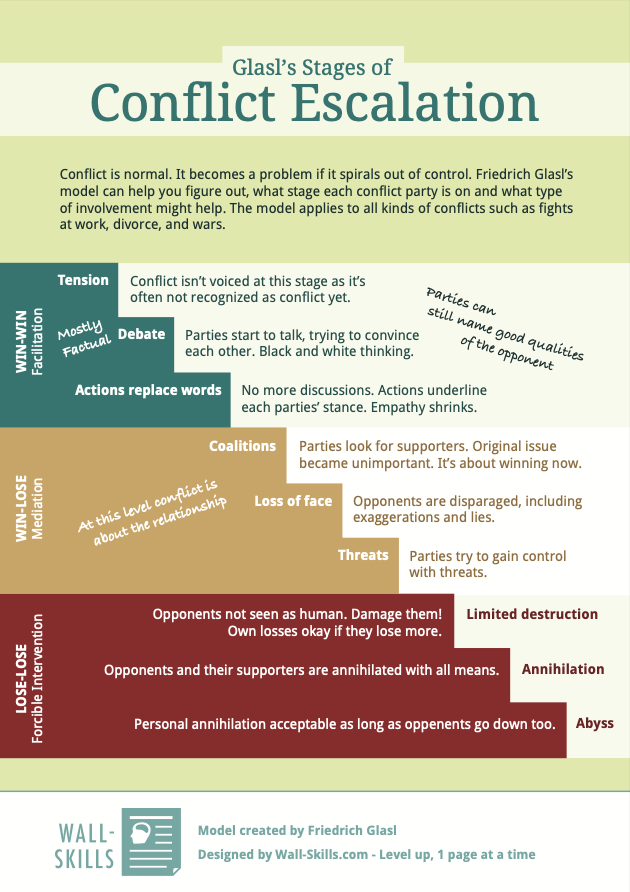
Check out Glasl’s Stages of Conflict Escalation to get a feeling for when facilitation and retrospectives can help and when they are doomed to fail and you need to bring reinforcements.
PS: If you'd rather read this Guide as an ebook, click here. Or go all in and get it as part of the Retromat eBook Bundle at a discount. A purchase also supports Retromat as a whole 🙂