
[This post is part of Corinna’s Guide to Facilitating Retrospectives]
Ahoy friend,
in my post about what I do while facilitating a retro, I said that I’m very hands-off as a facilitator. That doesn’t mean that I don’t influence where the conversation is going because I do ask questions and therein lies a lot of power. Let’s look at something I call “answer space”:
Answer space – The question shapes the direction of likely answers
One distinction you might know is the one between open and closed questions:
- Open: What could help you with that?
- Closed: Is there anything that could help you with that?
Which type you choose is one way to limit or broaden the answer space: The expected answer to a closed question is “yes” or “no”. The expected answer to an open question is some information or a story. In the example above “What could help you with that?” implies that there is at least one thing or person that can help. This implication makes it more likely that the other person will indeed come up with at least one thing.
You can use this deliberately: During the early stages of a retrospective we usually want to explore. Use powerful, open questions to invite a wide variety of answers.

In later stages, when we try to decide and wrap things up, closed questions are more helpful in narrowing things down and agreeing on actions.
But wait, there’s more! For example, you can influence people to look into their past or future:
- Past: What has helped you in the past in similar situations?
- Present: What could help you in the current situation?
- Future: What could help you in a similar situation in the future?
And we can focus on a problem versus an outcome:
- Problem: So, what’s the problem here?
- Topic / Neutral: Why did you come here today?
- Outcome: What would you like to have happen?
A question is like a ray of light that you can direct. What you shine a light on, can be seen more clearly and take up more (head) space.
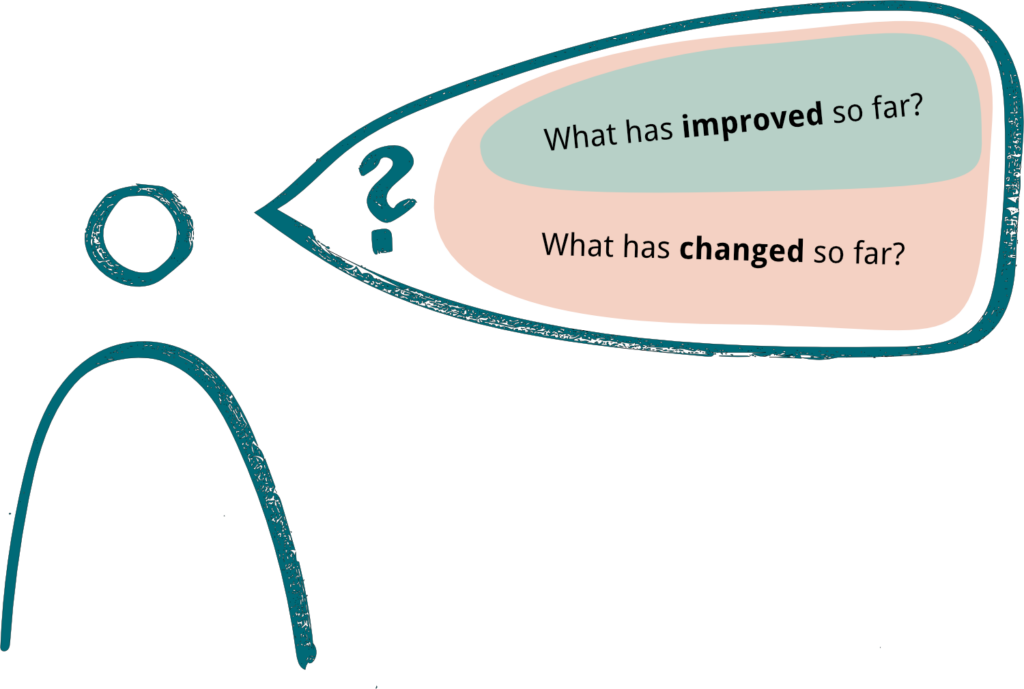
The question “What has changed?” has a rather broad answer space. Asking “What has improved?” limits the space of expected answers to positive points.
Obviously, the person you ask can also ignore the expectations behind your questions and answer outside of the intended space. They can answer the closed question “Do you have any plants?” with “Yes, a rubber tree and a small fern”. Or answer “What would you like to have happen?” with “Oh well, you know, that tracking system really is a pain in the butt”. But you can increase the odds of a certain type of answer. People are social beings that want to fulfill expectations. The chances of an answer inside your desired answer space are higher than of one outside of it.
Why is that important? How can we use this for good?
We can influence the energy levels with which people leave meetings run by us! And how much control they feel they have over a situation, and whether it’s worth it to attempt to change something at all.
When we ask “into” problems and have them described, energy typically goes down. In contrast, when we ask for things that have worked in the past, or have people envision a bright future in great detail, people typically gain energy. And this energy booster makes it easier to take the steps towards that brighter future. Hope makes way it easier to get started than from a ditch of discouragement in a situation that seems unchangeable.
Don’t get me wrong, I am not trying to steer clear of difficult topics, but rather that at the end of the retrospective I want people to feel that change for the better is possible. And that they are not at the very beginning of the process with lots of work still to do, but that they’ve already got contacts, skills and resources that can help them get there.
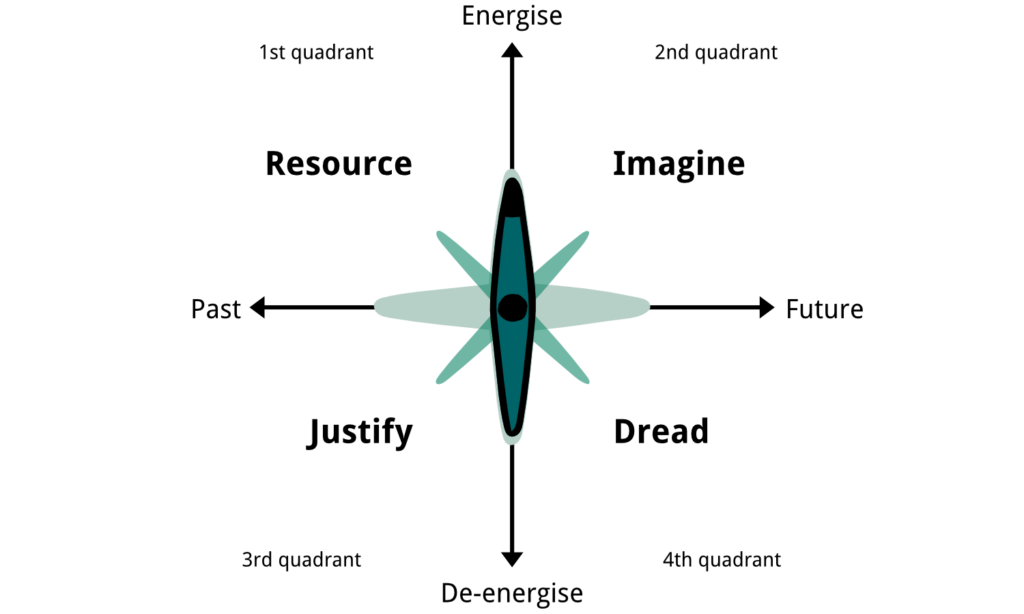
I ask questions whose answer space is in the upper two quadrants. I do it to focus the team on something that will give them energy (options) instead of leech it (all the ways things are shit) and on something they can change (the future) instead of something that is fixed (the past).
Are these leading questions, then? Ooof, not in the way that I’d understand a manipulative, suggestive question to be. What I mean is that while I pick my questions aiming for a helpful answer space, I do not have a specific answer in mind. I do not ask so that someone will suggest “more pairing” or “working agreement” or anything concrete like that.
If I want people to come to a specific conclusion I don’t ask. Instead, I offer it as a suggestion – that they can decline. I don’t play games where participants have to guess the “right” thing or where I’m disappointed and shrug my shoulders if they don’t guess what I’m hinting at.
As far as I’m aware of it, I don’t ask leading questions. But no matter what question you ask, you will influence the focus of your participants’ attention. And that is powerful. Use it for good!
If you’d like to know more about the kind of questions I ask, I go into a lot more detail in my free mini book “Asking for a Better Future”.
Take a minute:
Write down five questions that you typically ask during a retrospective. What answer space do they open up? What answers do you tend to get? Are you happy with the way these questions are working for you?
See you soon,
Corinna
PS: If you'd rather read this Guide as an ebook, click here. Or go all in and get it as part of the Retromat eBook Bundle at a discount. A purchase also supports Retromat as a whole 🙂