
[This post is part of Corinna’s Guide to Facilitating Retrospectives]
My dear friend,
we are nearing the end of this course. Obviously there are more resources for retrospectives out there than just Retromat. First and foremost the book that started my own journey so many years ago – It’s still the quasi standard and I highly recommend it: Agile Retrospectives.
In terms of finding activities, I pretty much use Retromat exclusively, since I built it to scratch my own itch. But if you’re looking for more variety, check out: FunRetrospectives.com and “games” at TastyCupcakes.org. (TastyCupcakes seems to be down as of October 2025)
For my final trick, I’d like to go beyond retrospectives and introduce some concepts that I found immensely useful during my journey as an Agile Coach. It’ll just be a sentence or two per idea and you can follow the link for the ones that seem helpful to you:
Liberating Structures
A treasure trove of facilitation methods that aim to involve as many participants as possible as active contributors, while still moving everything forward.
Host Leadership
You might have heard of Servant Leadership as a metaphor for roles like Scrum Master. It sounded good in 2010 when I started out. I quickly realized that it is very hard to set boundaries and establish “that’s not how we behave in this team / during this meeting / …” with that mindset. I think that Servant Leadership as a metaphor is seriously broken and that Host Leadership is the much more helpful metaphor. Servants can’t throw people out that ignore the community rules. Hosts can.
Multipartiality
For the longest time I thought it was my job as a facilitator to be neutral and impartial. Nowadays I believe I need to be multipartial, i. e. I need to be able to understand each party’s point of view.
SCARF
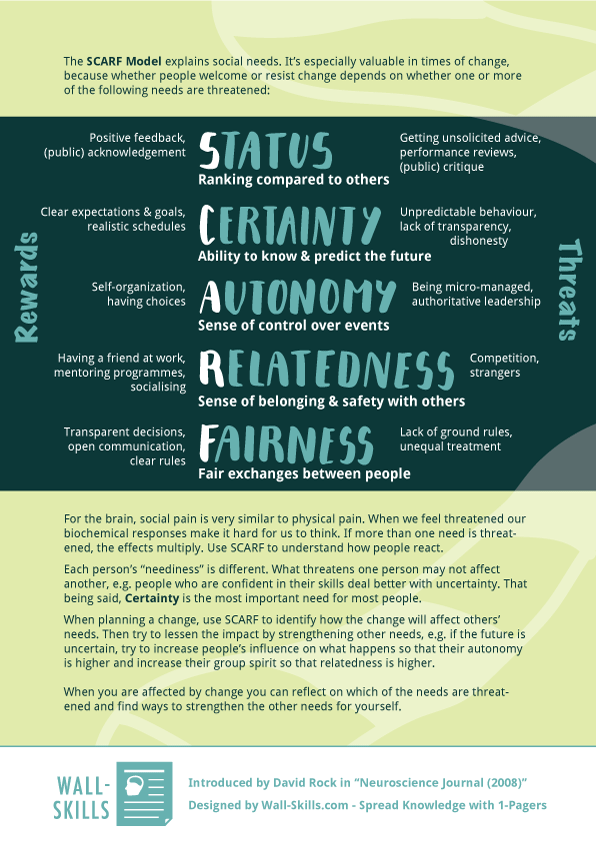
The SCARF Model explains social needs: Status, Uncertainty, Autonomy, Relatedness, and Fairness. It’s especially valuable in times of change, because whether people welcome or resist change depends on whether their SCARF needs are threatened or strengthened.
Clean Feedback
The world would be a much better place if more people were aware of the difference between their observations and their interpretations of these observations.
More on the Clean Feedback Model
Take a minute:
Which concept sounds like it could really help you in your current situation?
Please help me make this course better for everyone who will read it after you and tell me in the comments:
- What helped you?
- What was baffling?
- What are you still wondering about?
See you next time for my farewell message,
Corinna
PS: If you'd rather read this Guide as an ebook, click here. Or go all in and get it as part of the Retromat eBook Bundle at a discount. A purchase also supports Retromat as a whole 🙂